The Oracles: A Story About Clay
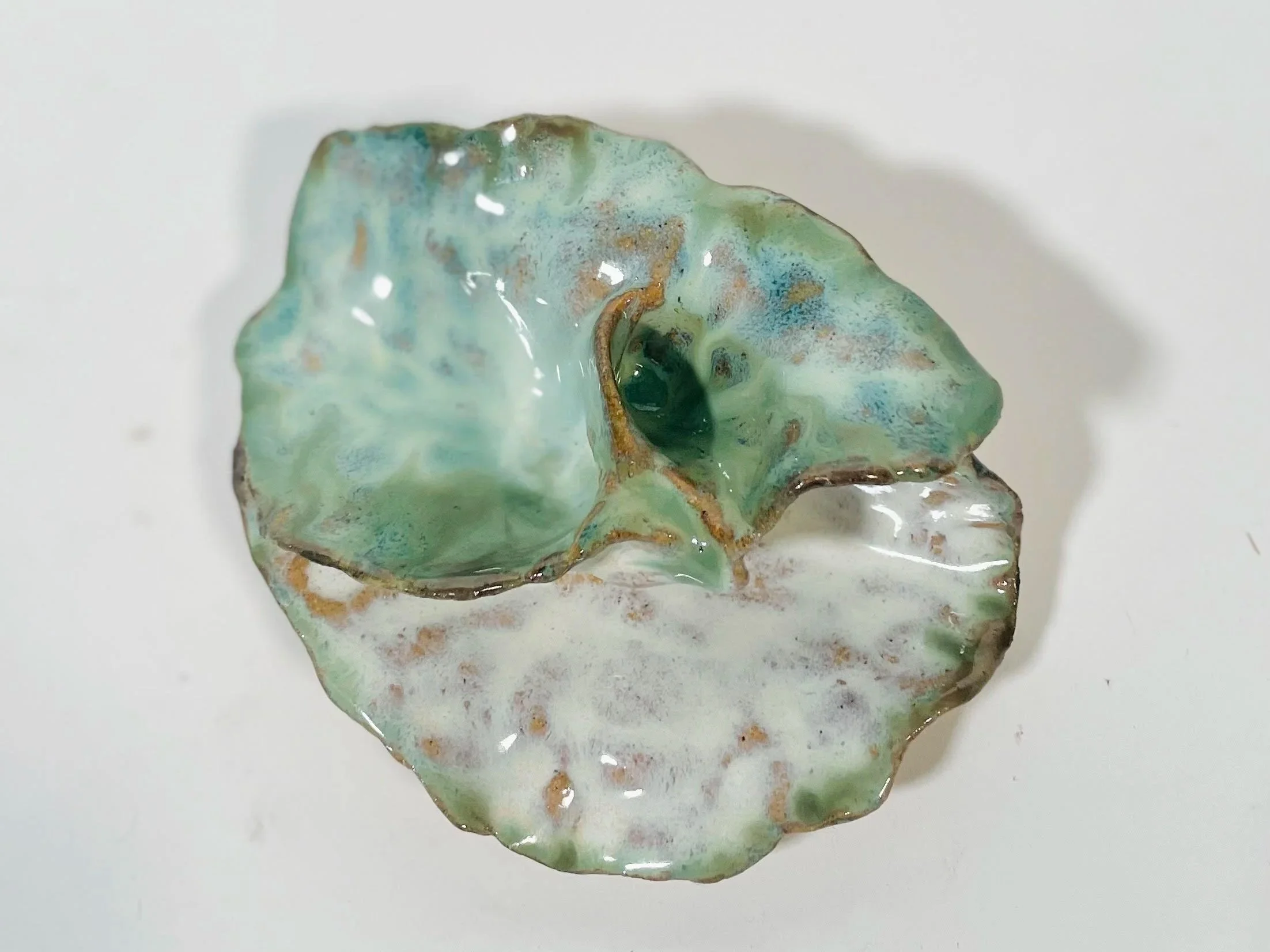
Unfolding Self (2024) by Zakkiya Khan.
1. Nature
The morning broke undecided, rain threading down in silver streaks before the sun pressed through, insistent. By the time she walked the long pathway toward town, the world was both damp and radiant. Water clung to the pavement in shallow pools, and when the light struck them, the ground shone back with a brilliance so fierce it was almost blinding.
She stepped into that brightness, into the warmth of sun on her face, and for a moment the world fell quiet. The shuffle of strangers beside her dimmed to shadows. The chatter and motion of the street dissolved. What remained was the path itself, a corridor of gold calling her forward.
Loneliness walked with her, as it always did, but here it softened. The light seemed to know her, to touch her skin as if she had been chosen for this moment. She breathed in the damp of stone lifting its scent into the air, the mingling of chill rain and sudden heat, and felt a truth rise in her chest: here, she belonged.
The world of people had often felt brittle, rejecting, but nature was steady. Nature had no quarrel with her sensitivity, no impatience with her silences. The trees at the end of the street stood tall as sentinels, their crowns shifting in the half-wind, watching her pass with a grace that dignified existence. She felt honoured to walk among them and felt their sway greet her as she walked by them.
She thought of her life, all the cities, all the beginnings, and the loneliness it brought. Yet here, with the glint of water and light pulling her toward something unnamed, she sensed that belonging was not a place at all, but a conversation with the elements that never turned her away.
2. Storm
The storm came without warning. A black sky rolling over the horizon, winds sharpening into knives, rain falling so hard it stung her skin. She ran until there was nowhere left to run and collapsed into the ditch at the edge of the forest. The ground swallowed her, cold and sodden, mud soaking into her clothes. Tears mingled with the rain until she could not tell which belonged to her and which to the sky.
She curled there, drenched through, shivering, the world’s grief pressing against her own. Each drop on her face was an echo of the isolation she endured; each gust of wind a reminder her. And yet, even in this assault, something stirred, a wild aliveness. To be so drenched, so defeated, was to be awake in every nerve. It was as if the storm was demanding she feel alive, even in these depths of grief.
When the rains eased, she rose unsteadily and followed the forest path inward. Her fingers found the earth, the sand and clay softened by water. She pressed her hands into it without thinking, needing the grounding of touch. The clay yielded, cool and pliant, slipping between her fingers as though it had been waiting.
She began shaping it in slow, instinctive motions. Not a craft, not a design, but a soothing, a stroking, the kind of repetitive gesture one makes when the body aches for comfort. Yet the clay responded. Water slid across its surface, guiding her hands, as though it were alive, as though it asked to be something.
From her palms bloomed a vessel: part leaf, part hand! It opened and closed as she worked, shifting under her touch, rotating like a living thing. She gasped, not with fear, but with recognition. The clay was holding her hand, shaping her as much as she shaped it, a companion in the darkness, the water activated its presence.
When it was finished, she left it nestled in the undergrowth. A small oracle, concave and gleaming, like a hand cupped toward the sky. Not for others. Not for use. A piece of herself left behind, a promise she could return to.
3. Capture
Days passed. Weeks. A season. She did not return for the vessel. It belonged to the forest now, vines creeping gently across its curve, squirrels darting past, leaves settling softly in its concave palm. She had left it as part of herself, yes, but also part of nature. A secret between her and the earth.
Until one morning, she opened the paper. A photograph stared back at her: her vessel, held in the gloved hands of a stranger. As a specimen. The article called it mysterious, unexplainable, a discovery of local importance. Soon, the story spread online. Pictures multiplied, voices speculated, interviews buzzed with theories. Who had made it? Why had it been left in the woods? Was it ancient? Was it art?
Her heart clenched. It was not meant for this. Not meant for the human gaze with its endless need for reasons, categories, explanations. To her, it was an oracle, a companion, born of storm and grief. To them, it was an artefact to be catalogued, captured, possessed.
She felt the violation keenly, a sharp tug inside her chest. A part of her had been taken captive, reframed, polluted by the world she had fled. Yet when the first wave of grief passed, something deeper whispered in her: let it go.
Nature had taught her this. Leaves fall, rivers swell, storms break, and all things move beyond control. She would not chase it back. Instead, she returned to the forest. She pressed her hands into the clay again, water seeping through her fingers, and let the making soothe her.
If they had taken one, she would make another. And another. Each one a conversation with the earth, each one an expression of her truth. She did not know, could not know, what would come of them.
But she knew she could not stop making more.
4. Echo
One vessel might have been dismissed as a curiosity. But when another was found, and then another, curiosity soured into unease.
They were not alike. One had the smooth curve of a leaf, another the ridged lines of bark, another three hollows that seemed to pulse with water even when dry. Each felt alive beneath the hand, carrying some unspoken presence. And when placed in homes, in galleries, in city offices, the presence grew.
A vessel born of loneliness turned rooms silent in darkness. Conversations faltered, footsteps slowed, until people found themselves face to face with their own solitude. Another, shaped in anger, cracked the plaster from a wall; winds howled in corridors where there should have been stillness and thunder shuddered. A vessel made in joy filled a café with sudden bloom, vines uncoiling from table legs, blossoms unfurling through the kitchens, petals scattering across terrazzo floors.
The city grew restless. Fear took root. These were not ornaments. They were mirrors, each one forcing people to confront what they most avoided: emotions: rejection, despair, longing, and tenderness.
She stopped making. Not out of choice, but because the oracles had become too much for the world. Her refuge was no longer hers alone; the forest had been invaded, and her griefs and joys, once private, were unravelling the fabric of the human world.
So, she did what nature had taught her: she watched. She stood at a distance and observed. Watch what happens, believe what you see.
And what she saw was a city turning against the very objects it had once praised. Fear rippled wider than curiosity ever had. Streets whispered of curses. Officials spoke of containment. The word “dangerous” surfaced in their mouths.
She said nothing. The oracles had spoken.
5. Return
At last, fear overcame fascination.
The council called emergency meetings. Scientists muttered about toxins, resonance, unexplained magnetic fields. Religious voices called them omens. Families whispered of hauntings in their walls. The verdict came not with clarity but with desperation: return them.
And so the city prepared a ritual of its own making. Men in white suits sealed themselves into masks and gloves. Yellow tape cordoned off streets. The vessels were handled as though they were volatile explosives, lifted with tongs, slid into padded crates, transported under flashing lights.
They were carried back to the forest. Not one at a time, but in a procession, as though the city wished to purge itself in a single ceremonious act. Officials placed them in the undergrowth, each marked carefully on maps, each returned as close as possible to the site of its finding. Cameras recorded every step, as if documentation could shield them from the mystery they feared.
She did not go. She did not intervene. She watched from the edge of her sanctuary as the humans filed out, their boots trampling leaves, their equipment humming with caution.
When the last crate was emptied, they withdrew. The forest closed behind them, indifferent.
The city waited. Quiet spread like fog. People held their breath for days, expecting more floods, more cracking walls, more silences heavy as stone.
But the forest gave no sign. The oracles remained, hidden among the bushels, dappled by light, vines already beginning to curl across their surfaces again.
And she, at a distance, waited too.
6. Restoration
When the forest grew quiet again, she felt her body loosen, as if some binding had been cut away.
It was not certainty that comforted her, she knew the oracles would always be unpredictable, beyond even her own understanding. What steadied her was the knowledge that they were no longer in human hands. Their return to the soil, to the trees, to the shadowed silence of the woods, gave her a strange relief.
She trusted their unpredictability more than she trusted people. Trusted the wildness in them, the way they carried her grief and joy without explanation, the way they spoke in elements instead of words. They were honest. Their courage felt safer to her than the masks of tidy categories and the demands and desires of the human world.
She did not know if the forest would ever again be the untouched refuge it had been. Yet the knowing itself was relief. The humans had stepped back. The oracles, whatever they would become, were free.
She closed her eyes. The rain-wet path, the golden light, the sentinel trees all of it returned to her in that moment. She breathed it in and let their memory rest inside her like a promise, she was honoured to be a passenger in their sacred world. Unseen and free, there she belonged. She belonged in the quiet trust of what she and the forest had made, and in the silence that followed.
Restoration.
